Myths
and Legends
There are many legends and myths associated with
Brimses and Brims Castle.
A selection are given below:
 Treasure Treasure
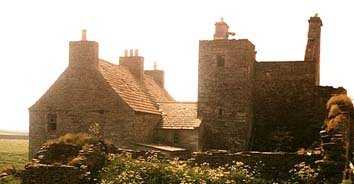
My Great Grandfather, William spoke to two fishermen both called
David Mackenzie (father and son - possibly the two
fishermen in the photograph) who lived in the grounds
of Brims Castle who, when they could not fish, spent their time digging
up the ground around the castle looking for the treasure that local
legend said existed. They had not found any treasure but had dug up
some skulls with holes in them!
Ghosts
 William
also says "I called this year (1910) at every house within miles
of the castle, trying to gather what legends there
were about it. I was assured by one old man that his old mother used
to tell of a legend she had heard that a Brims and occupant of the
castle sent a messenger into Thurso, to a joiner there, asking for
a coffin to be laid outside his shop at night. The coffin was removed
a dead of night and conveyed to Brims Castle. One of the servingmaids
at the castle had disappeared at the time. The matter was hushed up.
Local tradition was certainly convinced at that time that a crime
had been committed and that this servingmaid had been done away with.
The castle is haunted they say, by this white lady. " William
also says "I called this year (1910) at every house within miles
of the castle, trying to gather what legends there
were about it. I was assured by one old man that his old mother used
to tell of a legend she had heard that a Brims and occupant of the
castle sent a messenger into Thurso, to a joiner there, asking for
a coffin to be laid outside his shop at night. The coffin was removed
a dead of night and conveyed to Brims Castle. One of the servingmaids
at the castle had disappeared at the time. The matter was hushed up.
Local tradition was certainly convinced at that time that a crime
had been committed and that this servingmaid had been done away with.
The castle is haunted they say, by this white lady. "
Sir Walter Scott
William was convinced that Sir Walter Scott had used Brims Castle
as inspiration for his novel 'The
Pirate'. It is known that in the summer and autumn of 1814, Scott
travelled around the north coast of Scotland, Shetland, Orkneys and
Hebrides. Here is a quote from 'The Pirate' - you can make up your
own mind!
"....for a Norwegian Chief of those times, or, as other
accounts said, and as the name of Jarishof seemed to imply, and ancient
Earl of the Orkneys had selected this neck of the land as the place
for establishing a mansion house. It had been long entirely deserted,
and the vestiges only can be discerned with difficulty; for the loose
sand borne on the tempestuous gales of those stormy regions, has over
blown and almost buried the ruins of the buildings; but in the end
of the seventeenth century, a part of the Earls mansion was still
entire and habitable. It was a rude building of rough stone, with
nothing to gratify the eye or excite the imagination, a large old
fashioned narrow house, with a very steep roof, covered with flags
composed of grey sandstone, would perhaps convey the best idea of
the place to a modern reader. The windows were few, very small in
size, and distributed up and down the building with utter contempt
for regularity.
...a short distance from the mansion, and near to the sea beach, just were
the creek forms a sort of imperfect harbour, in which lay three or four fishing
boats, where were a few most wretched cottages...."
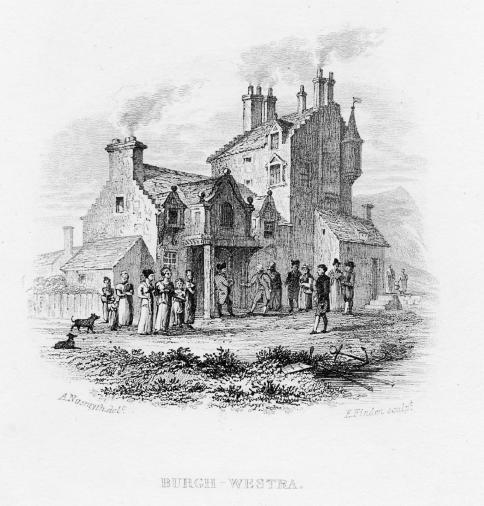
 As an interesting addition to this story, I was recently contacted
by someone from The
Walter Scott Digital Archive - where you can see several pictures,
depicting The Pirate. As an interesting addition to this story, I was recently contacted
by someone from The
Walter Scott Digital Archive - where you can see several pictures,
depicting The Pirate.
There
is one in particular picture that looks quite
like some features of Brims Castle - a depiction
of The
Pirate- subtitled "Burgh-westra" It
is a steel ingraving from a drawing by Alexander
Naysmith, 1832.
I am told that in the coming months there will
be many more pictures of this scene as it was
a particular favourite of Victorian artists.
Click the picture above for a larger version.
John Brymmes elder of Brymmes and his son
William, author of the Brimses of Brims, was amused
by the fact that in 1610, 'John Brymmes, elder of Brymmes
and his son', are convicted of sheep stealing. He suggested
the following story, in jest, as representative of
how they would return home in the evening, from visiting
the Laird! (Obviously he firmly feels that Brimses
are fond of a drink or two!)
Father and son, both broad, muscular
highlanders, dressed in kilt or plaid of Sinclair
tartan, holding onto each other, endeavouring
to keep on the path that is within a foot of
the perpendicular precipitous rock. "United they
stand, divided they fall!" At the top of their
voices they are yelling and singing, on their
way home, the refrain that they last sung at
the chiefs house, - "For he's a jolly good fellow!
For he's a jolly good fellow!! For he's a jolly
good fellow!!!"......and then with a sudden lurch,
John Brymmes, elder, disappears over the cliff,
drops down and bounds off from each projecting
crag right to a protruding rock 400ft below.
His son falls flat, and, rolling over to the edge of the cliff, looks down
into the gloomy depths. The wind is howling and the sea, with 50ft waves, is
lashing the rocks beneath; the spray is leaping often to the very top. The
moon occasionally comes out, and the blackness in places is intensified. "Faither!
Faither!" cries the son, and, hoping without hope, he looks and listens. Yes!
His practised ear detects the finish of the refrain "Which nobody can deny" in
his father's voice. His son hurries down and finds his father, who says he
has lost his bonnet. "Are ye hurt, Faither?" "Naw, I wis comin' doon whateffer." Together
they wend their way over sand and rocks, blaming the seaweed for being so slippery.
At last, they reach their hut, and, rolling away the big flagstone, which does
service for a door, they are greeted with the words: "Is that you John?" said
by his wife within. John has been trying to sober up a bit for the last hundred
yards. "Yes! it's me!"says John, "Whae - hic - whae was ye expectin?"
I have to stress, this is myth not legend!
Giants and Dwarfs
This legend was sent to me recently by Jan Sieroversche
from Holland. His family have connections with
the Brimses in 1620.
" In Old Scandinavian (and old English
and old Frisian) The word "Brimmisa" means "the
noise that the wind or weather makes" (breezy/stormy
weather) and it comes from the name "Brimmyr" who
was an angry dwarf and the ancestor of all the
dwarfs. This in context with the placename "Thurso" (that
doesn't mean Thor's place but Thurs place - place
of the giants) shows the historic struggle between
the Vikings (the Thurs or Giants) and the original
population of Celts (the Brimmysh or Dwarfs)".
I think this is especially interesting as in
my own 'branch' of the family at least, the Brimses
are all quite short!
The White Lady
Brims Castle is well known for having a ghost
- the white lady. Stories vary as to who she
was. In one, Patrick of Brims (aka Black Peter),
lived in the castle, and had a 'relationship'
with the daughter of James Sinclair of Uttersquoy.
The lady mysteriously disappeared.
It was hinted at that Patrick did away with
her and hid the body in some secret part of the
castle. Calder (who wrote 'The
Civil and Traditional History of Caithness')
believed that Byron modelled his work 'Manfred'
on Patrick. He believed that Byron was told the
legend by George Sinclair when they were both
at Harrow School.
|